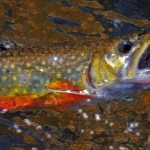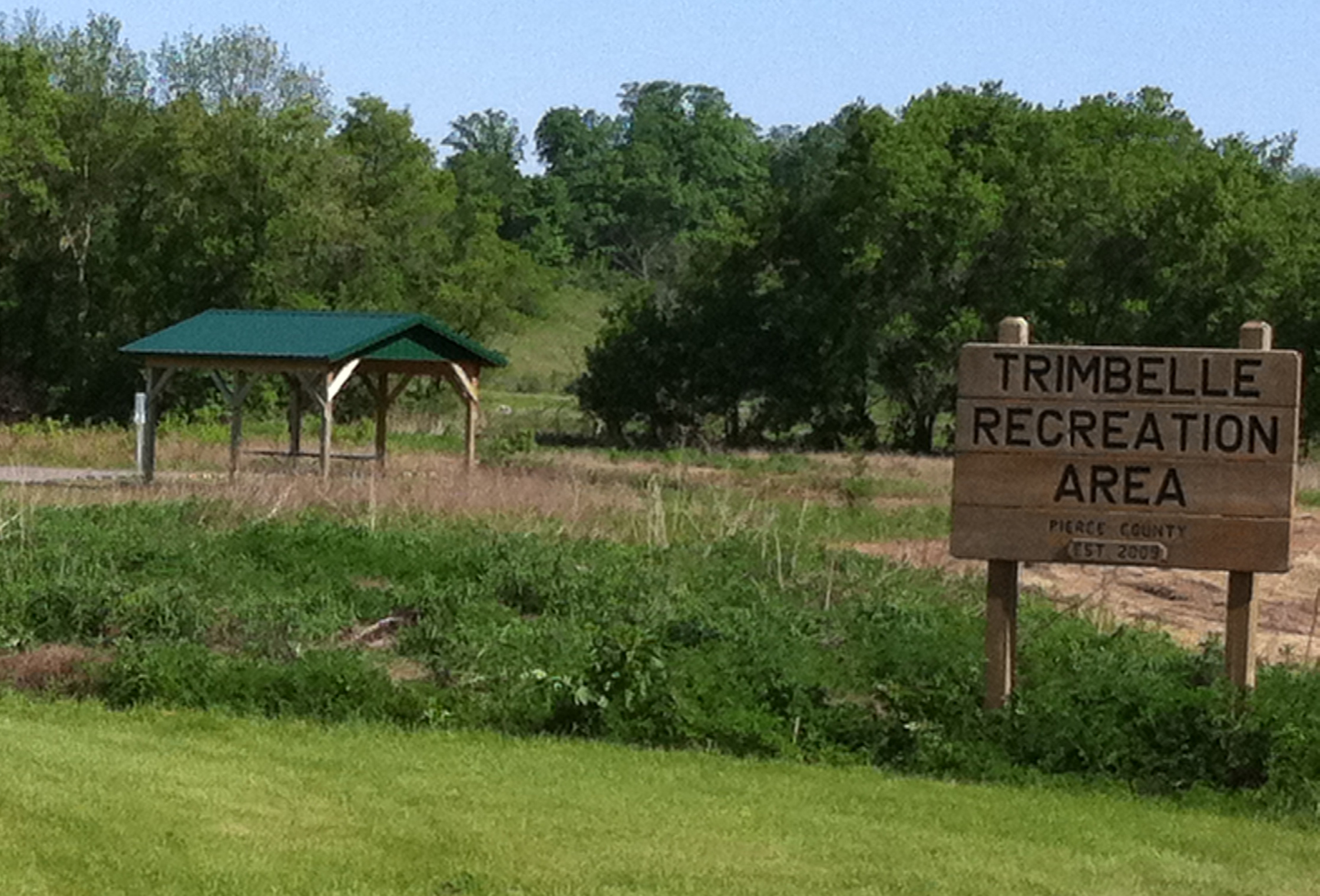
The River The Trimbelle River is located 36 miles southeast of St. Paul, Minnesota, a major metropolitan area of over 2 million people. The headwaters of Trimbelle River originate 6 miles east of River Falls in Pierce County, WI, flowing for 20 miles before discharging into the Mississippi River at the Trenton Slough. The Trimbelle has a population of Brown Trout that average 663 per mile in most areas. The once-thriving Brook Trout, are no longer in the Trimbelle. There are a few remnant populations in the headwaters of it's tributaries.Year-round flow in the Trimbelle River begins with a group of cold-water springs in northern Pierce County, Wisconsin. Some maps show the headwaters to be in a “dry run” a few miles north of these springs, roughly 5 miles east of River Falls. The entire length below the springs is designated by the state of Wisconsin as Exceptional Resource Water and as a Class II trout stream. Twenty-one miles south and 300 feet lower elevation it discharges into the Mississippi and Lake Pepin. Much of the headwaters / cold spring area is permanently protected from development because it is owned by government entities including the U.S. Army Corps of Engineers, the Wisconsin DNR, and the Wisconsin DOT. As it exits the wetlands area north of the community of Beldenville it is already several feet wide before it picks up the flow from additional springs and seeps. In the 8 miles or so from the cold spring area to Highway 10, the Trimbelle flows through a wide valley. It nearly doubles in size at the mouth of Goose Creek just west of Beldenville. Much of the stream bed is sandy, but with a gravel sub-strate. It courses alternately through wooded reaches and open farmland. The land is privately owned with two well-marked stretches that have fishing easements and that were the subject of habitat improvement projects in past years. Most of these projects involved the Trimbelle Rod and Gun Club which is now defunct. Below highway 10 the Trimbelle flows through a much narrower canyon or coulee, parallel to county highway O. There are seven bridges in seven miles, and the river has a riffle – pool – riffle character. In at least one place, it is possible to park near a bridge, fish up or down stream for a mile or so, and find yourself a couple hundred yards from where you parked. There were a half-dozen habitat improvement projects below highway 10, most of them done during the 1990s. Below the canyon stretch, the valley becomes wider and the bottom more sandy again, but still with sequences of riffles and pools. Below highway 35 and the railroad it flows for more than a mile within the Mississippi River flood plain and Trenton Slough. Skidmore Bluff and Trenton Bluff stand as sentinels on either side of this stretch of the Trimbelle. Tributaries Goose Creek originates just east of Beldenville, at the foot of several coulees and the intersection of county highways J and N. It flows west four miles through Beldenville and discharges into the Trimbelle about 100 yards south of 650th Street, adding more than 50% to the flow of the main river. Goose Creek is also designated as a class II trout stream. Local residents report that fishing success varies from year to year as high water events fill some holes with sand but create other new holes. Spring Creek originates on the west side of Ellsworth, flows generally westward, and discharges into the Trimbelle approximately one mile below highway 10. Although it may contain a small remnant population of brook trout, for nearly its entire length it is too small to interest most fishermen. The exception may be the last 100 yards near the mouth of the stream. It is designated Class II with a sufficient cold flow to sustain a population of trout. Little Trimbelle Creek begins in the south west corner of Ellsworth, flowing south and west to its confluence with the Trimbelle not far above Highway 35. It is a class II stream with a population of native brook trout. Fishing access is limited. Many other unnamed creeks also flow into the Trimbelle, scattered along its entire length. Some of these flow year-round and may provide spawning habitat. Restoration Projects: Highway 10 Pierce County Park Project in Trimbelle Recreation Area. Our most recent restoration project is in conjunction with the Pierce County Land Conservation Department, Pierce County Parks Department, and the Wisconsin Department of Natural Resources, Kiap-TU-Wish is currently coordinating efforts for stream habitat restoration in the Trimbelle Recreation area in Pierce County.The project will restore of nearly 1,000 feet of stream habitat for trout and other aquatic species in the project area, which is located approximately 5 miles west of Ellsworth on Pierce County Road O—just 1/2 mile south of U.S. Highway 10. This project provides brown trout conservation, protection, and will help reduce the need for stocking of non-wild hatchery brown trout in the river. The $69,000 project is projected for completion in summer of 2012. The project will also connect two previous habitat restoration projects completed in 2000 and 2007 above and below the project site. There is a recent Pierce County Park Department (landowner of this project) addition of picnic tables, shelters and parking area adjacent to the project area. The project will also lend itself well to educational opportunities and community access including a handicapped accessible fishing area. According to Chapter President Kyle Amundson, “The Trimbelle River is a watershed with exceptional water quality, and with some stream restoration work from Trout Unlimited and the WIDNR, it will become another exceptional trout fishery in Western Wisconsin." Project goals: 1. Stabilize severely eroding banks; 2. Provide in-stream cover; 3. Increase spawning habitat for trout in this section of the Trimbelle; 4. Reduce sediment and nutrient flow to Mississippi River The reshaping and sloping of steep, eroded banks will help accomplish this. Long-lived tree species to remain where possible while tapering stream banks. Banks will be stabilized with prairie grasses and in-stream habitat will be provided by LUNKER structures, plunge-pools and boulder clusters strategically placed within the stream. Where suitable, narrowing, deepening and speeding up current using proven techniques and lunker structures will be added to provide cover from predators and refuge during flood stage. These structures will be covered with rock and soil, and then reseeded to stabilize the banks. Plunge pools will also be installed to create deep water and over winter habitat. WDNR Fisheries Biologist Marty Engel states, “The addition of bank and other overhead cover along with increased depth will provide outstanding adult fish habitat. Overall, restoration of this stretch of stream will result in restoring natural reproducing trout populations, improved fishing access and fishability.” With stream restoration and other improvements in this section, Engel indicates that attainable use potential for the Trimbelle can move to Class I Water, reducing the need for stocking of non-wild trout in this section. Restoration experience on similar fisheries in Pierce County (Rush River), and other sections of the Trimbelle that have been restored, yield substantial increases in numbers and size. The bank stabilization and restoration in these streams also improved water quality by reducing in- stream sedimentation and polluted run-off. Funding: In addition to chapter donations of cash and volunteer labor to this project, Kiap-TU-Wish has acquired additional grant money, private donations, and partnerships to help fund this and other restoration projects on the Trimbelle River. A big thanks to Fairmount Minerals for providing numerous volunteers and much needed funding for this project. We'd also like to thank the following partners for helping fund this project: Pierce County Kiap-TU-Wish board and members Trout Unlimited Embrace-A-Stream Grant Wisconsin Trout Unlimited "Friends of WI TU" Patagonia Ellsworth Rod & Gun Club Fairmount Minerals Excel Energy James E. Dutton Foundation
Resource Challenges
As with most watersheds in the Driftless Region, the Trimbelle has outstanding water quality but suffers from severe bank erosion and unstable banks— resulting from years of poor agricultural practices. Historically, overgrazing has compounded the erosion and sedimentation problem. This bank erosion severely limits habitat and reproduction within the stream. Examples of this situation are dramatic and common throughout the watershed. The one-hundred-year flood of 2010 also damaged the stream’s hydrology and morphology. Erosion deposits have filled in-stream habitat, reduced spawning areas and cover for aquatic species. Undesirable overhead tree cover limits sunlight needed for aquatic vegetation and insect growth. |
|
|
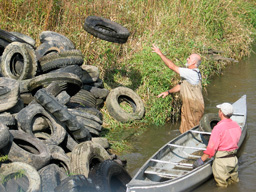
Due to erosion, much of the river above highway 10 is slower and wider than it might otherwise be, allowing it to acquire energy from the sun and atmosphere. River banks in this region are often vertical, two to four feet high, and are composed of a great deal of sand and finer material which erodes easily. The wooded stretches contain box elders and other invasive tree species whose roots do not anchor the soil well. The high vertical banks do not allow the energy of high flow events to dissipate, but rather contribute to further erosion. The eroding fine material tends to cover the gravel that trout require for successful spawning, and as it shifts it smothers smaller life such as insects. It also is ultimately carried downstream and discharged into Lake Pepin. The standard stream improvements consisting of removal of invasive plant species, narrowing the stream and raising the velocity, and grading the banks back to create a graded flood plain that dissipates the energy of high flow events. All of this reduces erosion significantly. Addition of lunker structures and deeper holes enables fish to avoid predators. Upstream from 570th avenue there is a tributary coulee that is usually dry, but it was used as a disposal site for used tires several decades ago. High water events occasionally carry old tires into the Trimbelle. In past years, the Trimbelle Rod and Gun Club periodically removed them. In October 2011 the Kiap TU Wish chapter of Trout Unlimited and other volunteers removed another 217 tires from the river. This will recur periodically unless a more permanent solution is implemented. There are no dams on the Trimbelle. All major federal, state, and county bridges are designed to allow all species (fish, insects, turtles, etc) to move up and downstream without hindrance. An inventory of private driveway crossings might reveal barriers in the form of inadequate culverts. Another definition: Outstanding and Exceptional Resource Waters Wisconsin has designated many of the state’s highest quality waters as Outstanding Resource Waters (ORWs) or Exceptional Resource Waters (ERWs). Waters designated as ORW or ERW are surface waters which provide outstanding recreational opportunities, support valuable fisheries and wildlife habitat, have good water quality, and are not significantly impacted by human activities. ORW and ERW status identifies waters that the State of Wisconsin has determined warrant additional protection from the effects of pollution. These designations are intended to meet federal Clean Water Act obligations requiring Wisconsin to adopt an “anti-degradation” policy that is designed to prevent any lowering of water quality, especially in those waters having significant ecological or cultural value. Outstanding Resource Waters (ORWs) typically do not have any point sources discharging pollutants directly to the water (for instance, no industrial sources or municipal sewage treatment plants), though they may receive runoff from nonpoint sources. New discharges may be permitted only if their effluent quality is equal to or better than the background water quality of that waterway at all times. No increases of pollutant levels are allowed. If a water body has existing point sources at the time of designation, it is more likely to be designated as an Exceptional Resource Water (ERW). Like ORWs, dischargers to ERW waters are required to maintain background water quality levels; however, exceptions can be made for certain situations when an increase of pollutant loading to an ERW is warranted because human health would otherwise be compromised (http://dnr.wi.gov/org/water/wm/wqs/orwerw/). Definition: Class II trout streams may have some natural reproduction but not enough to utilize the available food and space. Therefore, stocking is required to maintain a desirable sport fishery. These streams have good survival and carryover of adult trout.
Trimbelle River Tire Clean-up
Eleven
volunteers, working under the direction of Area Fisheries Manager Marty
Engel and Barbara Scott of the Wisconsin Department of Natural
Resources (DNR), turned out Saturday to remove waste tires from the
Trimbelle River. The project area location was approximately a quarter
mile upstream of the bridge at 570th Street.
The
impetus for the cleanup resulted after anglers expressed concern to the
DNR over a large number of tires deposited in a short stretch of
stream. Investigation revealed that they had been deposited there after
heavy flooding washed them in from an abandoned tire dump occupying a
dry run along the stream. Tire dumps such as these were once common in
rural areas; large numbers still exist across Wisconsin. The Kiap TU
Wish Chapter worked with Marty Engel to organize the cleanup efforts.
The
Trimbelle River watershed lies between the better known trout
fisheries of the Kinnickinnic and Rush Rivers. The Trimbelle has an
excellent trout fishery despite suffering from severely eroding banks.
Gary Horvath
Chapter Secretary
Kiap-TU-Wish Chapter of Trout Unlimited
|